
Part 2: Why Panic Is Required
By Domesticated Warrior
If this were truly about child safety, panic would be unnecessary. Calm facts, transparent risk discussions, and informed parental decision-making would be enough. Instead, fear has become the primary tool—because the current policy framework does not function without it.
Are Vaccination Rates Down?
Yes. Routine childhood vaccination rates have declined since 2020, particularly among kindergarten and early elementary-age children. Even the Centers for Disease Control and Prevention has acknowledged this in its surveillance data.
The reasons are not controversial:
Pandemic-era school disruptions
Missed well-child visits
Increased parental demand for informed consent
Greater use of lawful exemptions
This reflects a shift in parental behavior—not a sudden collapse in child safety.
Do States Get Paid Per Vaccinated Child?
Not in the simplistic way often implied.
But what is true—and rarely explained—is that vaccination rates indirectly affect funding, authority, and institutional relevance.
How the Incentives Actually Work
Public-health funding is heavily tied to:
Coverage benchmarks
Compliance metrics
“Risk reduction” models
Lower rates do not shrink public-health systems.
They trigger escalation.
The same pattern exists through Medicaid administration, vaccine reimbursement structures, and grant-funded partnerships with nonprofits and advocacy organizations—many of which depend on demonstrating “vaccine hesitancy” to sustain funding.
In short: panic unlocks resources.
Why the Media Narrative Matters
If this were genuinely about risk, we would see:
Honest discussion of absolute vs. relative risk
Transparency about lawful exemptions
Equal attention to informed consent and vaccine injury
Instead, we see:
Alarmist language
Parents framed as threats
Suppression of nuance
Silence on natural immunity
That pattern points to institutional self-preservation, not public education.
The Line That’s Hardest to Gaslight
Vaccination rates are down.
States are not paid a simple per-child bounty. But funding, authority, and relevance depend on maintaining urgency.
That is not a conspiracy.
It is how bureaucratic incentive structures work.
The most accurate way to say it is this:
Child safety is the stated justification.
Funding streams and institutional survival are the operational drivers.
Bottom Line
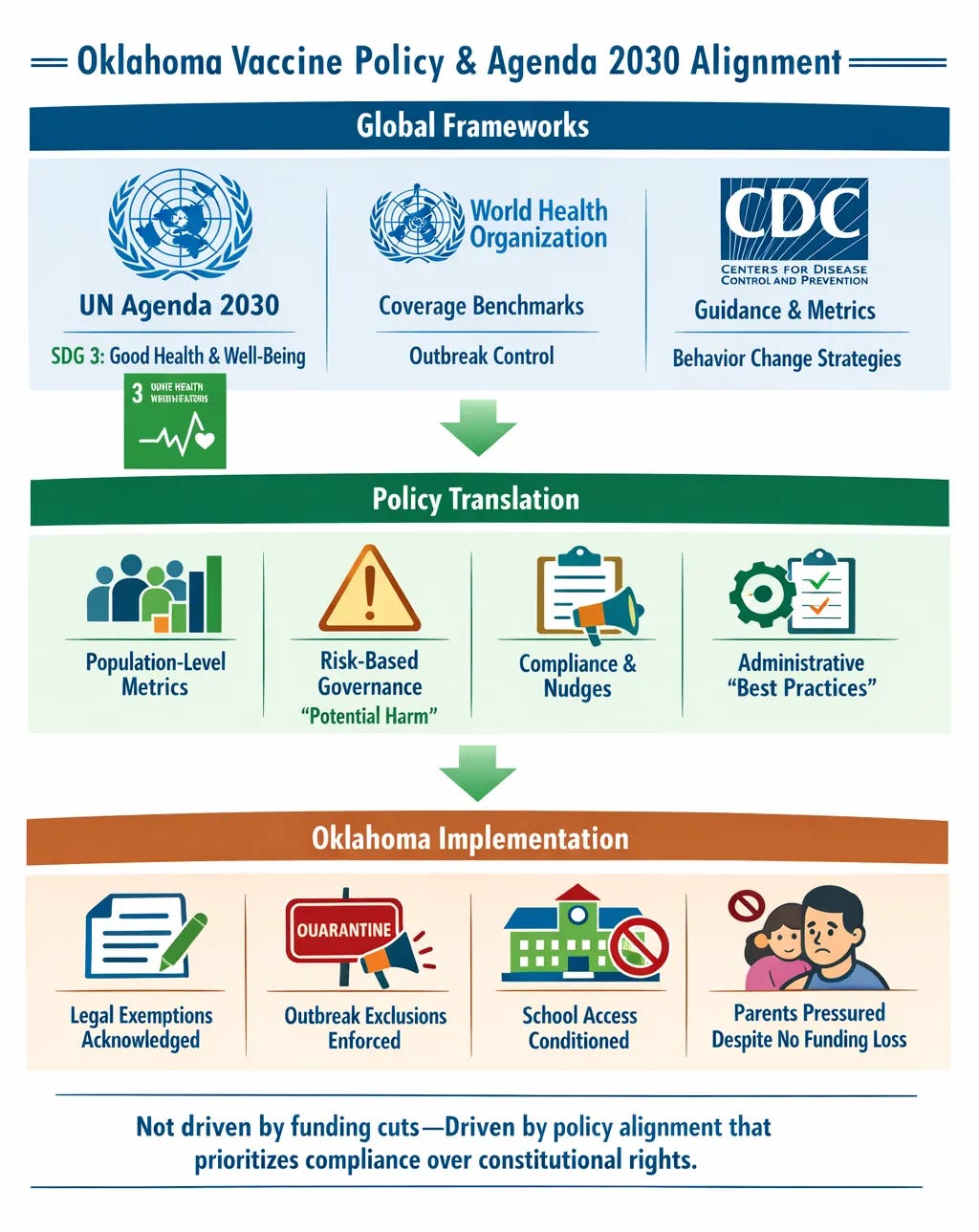
Oklahoma’s approach to childhood vaccination enforcement increasingly reflects alignment with Agenda 2030–style public-health governance, not funding necessity. While legal exemptions remain on paper, real-world policies prioritize population-level compliance metrics, risk-based decision-making, and behavior-change strategies promoted by global frameworks such as United Nations Agenda 2030 (SDG 3: Good Health and Well-Being) and operationalized through guidance from the World Health Organization and Centers for Disease Control and Prevention. These frameworks emphasize preventive uniformity and “community risk” over individualized rights, resulting in soft-coercive practices—such as exclusion during outbreaks and administrative pressure—that effectively undermine parental choice without changing statute. This represents policy harmonization, where guidance and metrics quietly override constitutional protections and informed consent, even in the absence of funding penalties.
If safety were the priority, transparency would be non-negotiable.
If compliance is the priority, fear becomes the tool.
What we’re seeing looks far more like the second.
Because none of this functions without panic.
Well said.